
- Birmingham Tree Care Pros — Local Pricing Guide
How Much Does Tree Removal Cost in Birmingham, AL?
(2026 Price Breakdown)
- 📅 Updated 2026
- 📍 Birmingham, AL + Jefferson County
- ⏱ 8 min read
- ✍ Birmingham Tree Care Pros
Short answer:Tree removal cost in Birmingham, AL typically runs $300–$2,500 for most residential jobs. Large trees — 60-foot oaks, storm-damaged pines, or anything requiring crane access — can reach $3,000–$4,500+. The wide range isn’t arbitrary: size, location, condition, and access all move the number significantly. This guide breaks down every factor with real Birmingham pricing so you know what to expect before you call anyone.
What's inside this guide
- What's Actually in the Quote
- Average Cost by Tree Size
- Key Factors That Drive Price
- Dead & Fallen Tree Costs
- Emergency Tree Removal Cost
- Stump, Roots & Branch Costs
- Removal vs. Trimming
- How to Get a Fair Price
- When to Call a Professional
- FAQs
What's Actually Included in a Birmingham Tree Removal Quote?
- Safe dismantling and removal of the trunk, limbs, and canopy
- Branch chipping and debris cleanup from the work area
- Wood hauling and disposal (or stacking if you want firewood)
- Full site raking and blowdown after the job
- Labor, equipment, and liability insurance
Average Tree Removal Cost in Birmingham: Size-by-Size Breakdown
Tree height is the single biggest driver of removal cost. Everything else being equal, a taller tree means more cutting time, more debris, more equipment, and more risk. Here’s what Birmingham homeowners typically pay:
| Tree Size | Height Range | Average Cost in Birmingham | Notes |
|---|---|---|---|
| Small tree removal cost | Under 30 ft | $300 – $700 | Ornamentals, young pines |
| Medium tree | 30 – 60 ft | $700 – $1,500 | Most residential removals |
| Large tree removal cost | 60 – 80 ft | $1,500 – $2,500 | Mature oaks, tall pines — common in Homewood, Mountain Brook |
| Extra-large tree | 80+ ft | $2,500 – $4,500+ | May require crane access; always requires on-site assessment |
Tree Removal Cost Calculator
Instant estimate for Birmingham, AL
$300
$900
$4,500+
Free
A few Birmingham-specific notes on species: oak tree removal cost runs higher than the chart suggests because mature water oaks in Jefferson County regularly reach 70–90 feet with wide canopy spread and shallow root systems. Pine tree removal cost — especially Loblolly pines, which are everywhere in Trussville and the eastern suburbs — depends heavily on whether the tree is healthy (easier to fell) or diseased (requires more careful sectional work).
The most reliable number comes from a free on-site assessment. A quote over the phone is just an estimate — the actual price depends on access, lean, what’s around the tree, and ground conditions. Any company that gives you a firm price without seeing the tree should give you pause.
Key Factors That Drive Tree Removal Cost in Birmingham
Two trees of the same height can have very different removal costs. Here’s what actually moves the number up or down — and why each of these matters specifically in the Birmingham market.
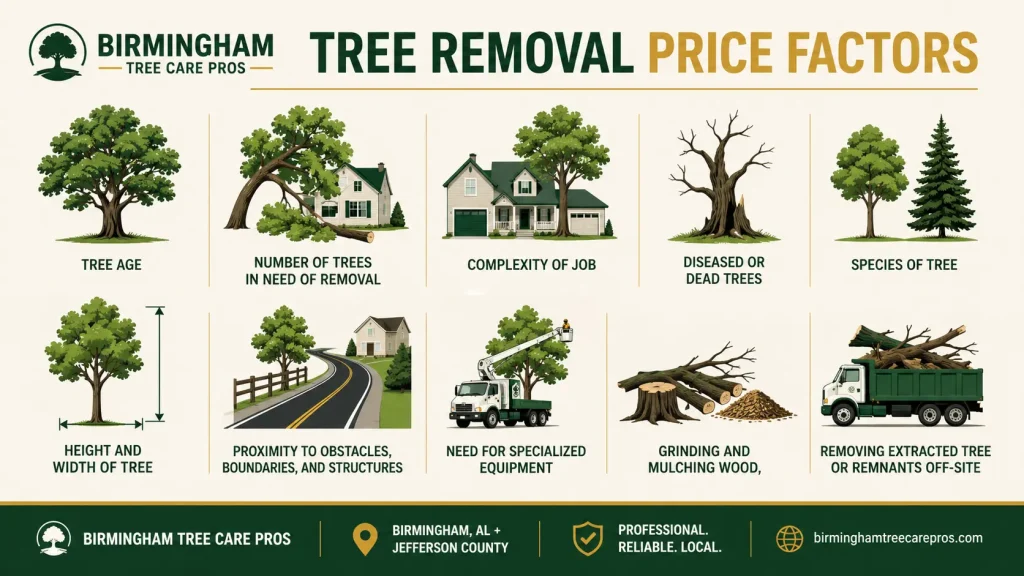
Tree Size & Height
The primary cost driver. Every additional 10 feet of height means more time, more cutting passes, more debris volume, and higher equipment requirements. A 30-foot Bradford pear and a 70-foot water oak are genuinely different jobs.
Location & Access
Trees in tight Birmingham lots — close to a fence, a roofline, a utility line, or a neighbor's property — require controlled sectional dismantling. That takes more time and skill than a tree in an open backyard. Crane access can also be a factor if the only equipment path is through a gate.
Tree Condition
Healthy trees are more predictable. Dead, diseased, or structurally compromised trees behave differently under a chainsaw — roots may be rotted, the wood may split unexpectedly, and lean direction is harder to control. That unpredictability is priced into the quote.
Tree Species
In Birmingham, water oaks, Loblolly pines, sweet gums, and hickories each have different removal challenges. Oaks are dense and branch-heavy. Pines can be brittle when diseased. Hickories have deep root systems. Species matters beyond just height.
Proximity to Power Lines
Trees growing into utility easements require coordination with Alabama Power and must follow specific clearance protocols. ISA Certified Arborists are trained for this work. It's not a DIY situation — and it adds to the cost of removal.
Crane Requirements
Most residential jobs don't need a crane. But when access is severely limited — a backyard surrounded by structures, a tree leaning over a pool — crane tree removal cost increases significantly. Crane mobilization alone adds $300–$600 to a job.
One factor many homeowners don’t think about: Birmingham’s red clay soil. In areas like Mountain Brook, Homewood, and older neighborhoods near UAB, mature trees have been growing in dense clay for 50–80 years. Root systems can extend far beyond the canopy, and clay holds moisture in ways that affect root decay patterns. When an arborist sees clay soil and a large dead tree, they account for that in their approach — and in their price.
Dead Tree Removal Cost & Fallen Tree Removal Cost in Birmingham
Dead Tree Removal Cost
Dead trees are almost always more expensive to remove than healthy ones of the same size — and it’s not arbitrary markup. Here’s the honest reason: a dead tree is unpredictable. A dead water oak in Birmingham red clay can have root decay you won’t see until you start cutting. The wood may split against the grain. Lean direction is harder to read and harder to control. Our arborists always do a probe assessment on dead trees before they quote, specifically because of what can be hiding below ground in Jefferson County clay.
For a dead tree under 40 feet, expect to pay roughly $400–$900 in the Birmingham area — about 20–30% more than a healthy tree of the same size. Larger dead trees (60+ feet) can run $1,800–$3,500+ depending on lean, proximity to structures, and how far the decay has progressed. The dead tree removal cost goes up sharply when the root system is compromised, because controlled felling isn’t possible and the tree must come down in sections from a bucket truck.
Fallen Tree Removal Cost
A fallen tree is a different job than a standing removal, and the fallen tree removal cost reflects that. If the tree is already on the ground in an open area — away from structures, accessible by equipment — it can actually be cheaper than a standing removal because there’s no controlled felling involved. Expect $200–$600 for a straightforward fallen tree cleanup in Birmingham.
The complication is when a downed tree has fallen onto something: a roof, a fence, a car, a neighbor’s yard. Now you’re dealing with extraction — carefully removing the tree without causing more structural damage — and that brings the downed tree removal cost up to $800–$2,500+ depending on the situation. After major storms in Jefferson County, this is the most common call we receive.
In Birmingham’s summer storm season — July through September — dead trees are the number one cause of property damage from wind events. A tree that looks stable in June can be on your roof by August. The cost of removal is always less than the cost of insurance claims, roof repairs, and emergency response fees.
Emergency Tree Removal Cost in Birmingham
When a tree comes down in a storm at 11pm — or is leaning against your garage after a strong wind event — you’re not shopping for the best price. You’re calling for help. Here’s what emergency tree removal cost looks like in the Birmingham area.
Same-day or after-hours emergency response carries a premium, typically $1,000–$5,000+ depending on the size of the tree, time of day, and complexity of extraction. That range is wide because the variables are wide. A small fallen pine blocking a driveway at 8am is a very different job than a 70-foot oak on a roof at 2am that requires a crane.
The most common driver of high storm damage tree removal cost in Jefferson County isn’t the tree itself — it’s demand. After a significant storm event, every reputable crew in the market is booked. That’s when fly-by-night contractors show up offering cash deals with no insurance. Don’t take that risk. Verify insurance before anyone starts work on your property, because if a worker is injured on your property without proper coverage, liability can fall on you.
If you’re dealing with a tree that poses immediate danger — on a structure, blocking an exit, threatening a utility line — call us directly rather than submitting an online form. We dispatch emergency crews across Birmingham and Jefferson County and prioritize life-safety situations.
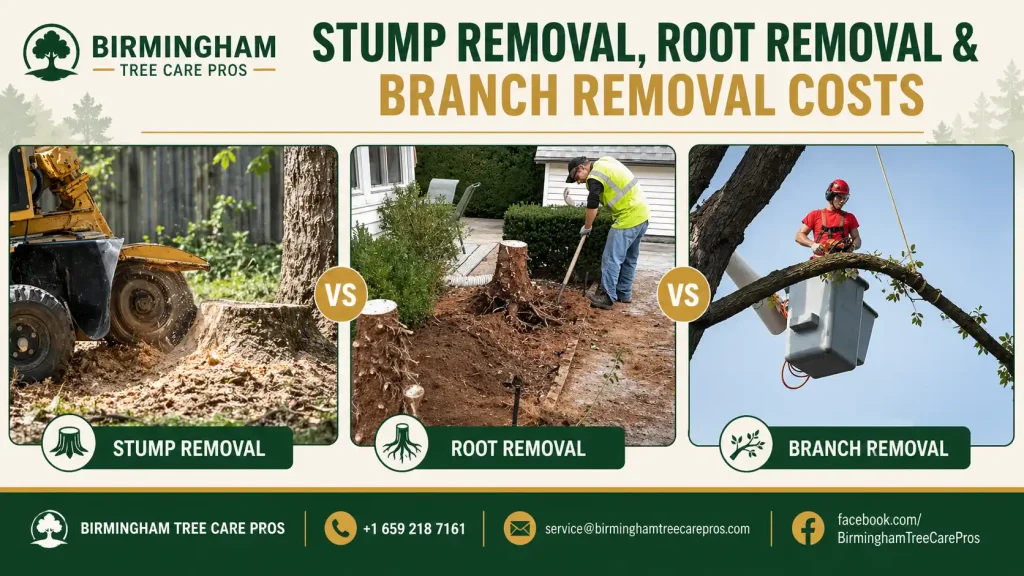
Stump Removal, Root Removal & Branch Removal Costs
Tree Stump Removal Cost
Stump grinding is rarely included in the standard tree removal price — it’s quoted separately because not every homeowner wants or needs it. Some clients use the stump as a garden feature. Others plan to remove it themselves. We quote it as an add-on so you only pay for what you actually want.
In Birmingham, tree stump removal cost typically runs $100–$400 per stump depending on diameter. A 12-inch stump and a 36-inch stump are genuinely different jobs — wider stumps take significantly longer to grind below grade. The honest advice: bundle stump grinding with a tree removal job whenever possible. You’ll pay less per stump (we’re already there with equipment) and avoid a second mobilization fee later.
We grind flush with the ground or below grade depending on your plans. If you want to re-seed or sod the area, we recommend below-grade grinding and backfilling the hole with the wood chips and topsoil.
Tree Root Removal Cost
Root removal is a separate service from stump grinding. Grinding removes the stump down a few inches below grade; root removal addresses the lateral root system that extends outward from the base. This matters when roots are lifting a driveway, invading a foundation, or blocking drainage. The cost to remove tree and roots varies considerably based on root depth and spread, but budget $150–$500+ beyond the stump grinding cost for significant root extraction work.
Tree Branch & Limb Removal Cost
Not every job needs a full removal. When a tree is structurally sound but has a hazardous limb — overhanging the roof, rubbing against power lines, or damaged after a storm — branch removal is the right call. Tree branch removal cost and tree limb removal cost in Birmingham typically range from $150–$600 per limb, depending on size, height, and access.
Larger, high canopy work that requires a bucket truck will be priced higher than ground-level branch work. A good rule of thumb: if the branch in question is more than 4 inches in diameter and over 20 feet up, it’s a professional job. The cost of the branch removal is a fraction of the cost of it falling on your roof.
Get a Free Estimate for Any of These Services
Whether you need a full removal, stump grinding, branch work, or just an assessment — we provide free on-site quotes across Birmingham and Jefferson County.
Tree Removal vs. Tree Trimming Cost — Which Service Do You Actually Need?
One of the most common questions we get from Birmingham homeowners is whether a problem tree needs to come down or just needs work. It’s a fair question, and the answer matters — tree trimming cost is significantly less than full removal, so if trimming solves the problem, that’s the right call.
| Service | Typical Cost in Birmingham | When It’s the Right Choice |
|---|---|---|
| Tree Trimming Cost | $200 – $1,000 | Structurally healthy tree with overgrown or hazardous branches; clearance pruning near structures or power lines; shape and aesthetic work |
| Tree Removal Cost | $300 – $4,500+ | Dead, dying, or severely diseased tree; structural failure risk (leaning, root damage, trunk cracks); removal needed for construction or land clearing |
The average cost of tree trimming in Birmingham for a standard residential job — crown thinning, deadwood removal, some canopy clearance — runs $300–$700. That’s for a crew, equipment, and cleanup. How much does tree trimming cost for larger, more complex trees? A 60-foot oak with extensive crown work can run $800–$1,200+, still significantly less than removing it.
Our ISA Certified Arborists will tell you honestly which option is appropriate. If a tree can be saved with trimming and targeted treatment, we’ll say so. Removal isn’t always the answer — and frankly, a well-maintained tree adds real value to Birmingham property. We’d rather preserve a healthy 60-year-old oak than take it down unnecessarily.
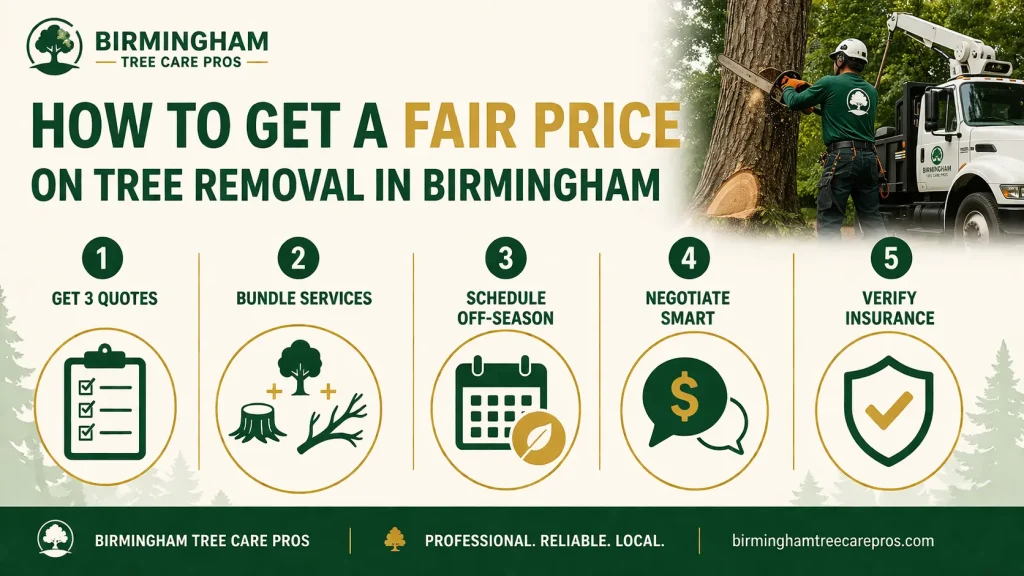
How to Get a Fair Price on Tree Removal in Birmingham
Tree removal is one of those services where the cheapest quote is often not the best deal. But there are legitimate ways to reduce your total cost without cutting corners on safety or quality.
Get at least three quotes. Pricing varies meaningfully between companies in the Birmingham market. A range of three quotes gives you a realistic sense of the fair market price and flags outliers on both ends. If one quote is dramatically below the others, ask what’s not included.
Bundle services together. Honestly, the single biggest mistake Birmingham homeowners make is not getting stump grinding quoted at the same time as the tree removal. When we’re already on-site with equipment, the stump adds maybe $150–$200 to the job. If you call back two weeks later for stump removal alone, you’re paying mobilization costs on top of the grinding fee. Same applies to branch work — if you have multiple items across the property, combining them into one job always costs less per item.
Schedule during the off-season. Low cost tree removal is most available from November through March in Birmingham. Demand drops after storm season, crews have availability, and some companies offer reduced rates to fill the schedule. This isn’t true for emergency work, but for non-urgent removals it’s a real opportunity.
Ask about tree removal cost negotiation — but be realistic. Most reputable companies have costs they can’t negotiate away: insurance, equipment, crew wages. But there’s often flexibility on scope — keeping the wood yourself (firewood value), accepting a longer scheduling window, or waiving same-day cleanup in exchange for a lower price. Ask, and see what’s possible.
Verify insurance before anything else. This isn’t about saving money upfront — it’s about avoiding a potentially catastrophic cost. Ask for a certificate of insurance. A crew member injured on your property without proper workers’ comp coverage can become your financial liability. Proper insurance is non-negotiable, even if it means paying slightly more for the job.
When Should You Call a Professional Tree Removal Service?
Some tree situations are obvious emergencies. Others are slower-moving risks that homeowners tend to watch and wait on longer than they should. Here are the signs that it’s time to call — not next season, but now.
- The tree is visibly leaning, and it wasn’t leaning before. New lean is a root failure signal, not just aesthetics. In Birmingham’s clay soil, root systems can let go suddenly after heavy rain saturates the ground.
- Large cracks or splits in the trunk or major limbs. These indicate structural failure that won’t self-correct. A cracked branch over a roofline is a roofing claim waiting to happen.
- Mushrooms or fungal growth at the base of the tree. Fungal fruiting bodies typically appear on dead or dying wood. By the time you see mushrooms at the base, root decay is usually significant.
- More than 50% of the crown is dead or dropping branches. A tree shedding major limbs during calm weather — not storm events — is in advanced decline.
- The tree has been struck by lightning. Lightning strike damage isn’t always visible on the outside. An arborist assessment after a strike is worth the cost of the visit.
- Roots are visibly lifting the driveway, foundation, or sidewalk. Surface root damage means the root system is aggressive and potentially compromising structures underground.
If you’re uncertain, a professional assessment from an ISA Certified Arborist is the right first step. We assess the tree, explain what we’re seeing, and give you an honest recommendation — including “leave it alone, it’s fine” when that’s the right answer. Check the City of Birmingham’s guidelines on tree ordinances and permit requirements for protected trees before any removal, especially in historic districts.
Tree Removal Cost Birmingham AL — Frequently Asked Questions
Real answers to the questions Birmingham homeowners ask most about tree removal pricing.
Tree removal cost in Birmingham, AL typically ranges from $300 for small trees (under 30 feet) to $4,500+ for large trees requiring crane access. The most common residential removal — a medium tree in the 30–60 foot range — runs $700–$1,500. Those numbers assume a straightforward job; proximity to structures, power lines, or tight access can move the price higher. A free on-site assessment is always the most reliable way to get an accurate figure for your specific tree.
The average tree removal cost for a residential job in Birmingham is roughly $800–$1,200, reflecting the area’s common mix of medium-to-large trees and tight urban lots. This is somewhat higher than national averages because Birmingham’s older neighborhoods feature large, mature hardwoods — water oaks, hickories, sweet gums — that require more skilled labor and equipment than younger, smaller trees in newer suburban markets.
Large tree removal cost in Birmingham (60–80 feet) typically runs $1,500–$2,500. Extra-large trees over 80 feet — and trees requiring crane access due to location — can reach $3,000–$4,500+. The cost to remove a 100-foot pine tree in a tight Birmingham lot can exceed $5,000 when crane mobilization, rigging, and sectional dismantling are all required. These jobs always need an on-site assessment to price accurately.
Not because of the zip code — but often because of the trees. Mountain Brook and Vestavia Hills have some of the oldest residential tree canopies in the metro area, with large water oaks, white oaks, and hickories that have been growing for 60–80 years. Older trees in these neighborhoods tend to be larger, closer to structures, and harder to access than trees in newer developments in Trussville or Alabaster. The complexity of the job drives the cost, not the address. Some Mountain Brook homes also have protected tree ordinances that affect removal permitting — worth checking with the city before proceeding.
No — stump grinding is almost universally priced as a separate add-on, not bundled into the tree removal price. In Birmingham, tree stump removal cost typically runs $100–$400 per stump depending on diameter. The smart move: request the stump grinding quote at the same time as your tree removal. When we’re already on-site with equipment, the per-stump cost is considerably lower than a separate mobilization. We also include wood chip backfill to minimize the hole left behind.
Emergency tree removal cost in Birmingham typically runs $1,000–$5,000+ for same-day or after-hours response, depending on tree size, time of day, and whether the tree has landed on a structure. Storm damage tree removal cost is higher not because companies are gouging — it’s because crews are stretched during high-demand periods, jobs require emergency protocols, and after-hours work carries real operational costs. One critical warning: after major storms, unlicensed contractors flood the Birmingham market. Always verify insurance before any crew starts work on your property.
Tree height is the primary driver — it directly determines labor time, equipment requirements, and debris volume. After height, the biggest cost factors are: location (tight lots, proximity to structures, or power lines add significant labor time for controlled dismantling), condition (dead or diseased trees are less predictable and priced accordingly), and species (large hardwoods like water oaks and hickories are more complex than comparably-sized pines). Access — whether equipment can reach the tree — also affects whether crane use is necessary, which is a meaningful cost jump.
It depends on the tree’s size, location, and which municipality governs your property. The City of Birmingham has tree protection ordinances that may require permits for larger trees, particularly in protected zones or near easements. Mountain Brook, Vestavia Hills, and Homewood each have their own tree ordinances with different thresholds. Our team is familiar with Jefferson County municipal codes and will advise you on permit requirements during your free assessment — and assist with the application process when needed.
Ready for an Accurate Price? Get Your Free Estimate Today.
We assess your tree on-site, explain your options clearly, and give you a written quote with no obligation. Serving all of Birmingham and Jefferson County.